
Millions of trades
happen each day. Only a few of
them really matter.
Pinpoint Alpha is curated market research: an evening brief on the market and the stocks you follow, built from filtered options flow and large trades, with supporting dashboards.
In your inbox by 6 PM ET, the essentials in five minutes
Every weekday evening, Pinpoint deconstructs the day's options flow, large trades, and key price levels. Then it tells you where the market and up to 15 stocks you follow stand, what changed since yesterday, and the levels that matter.
- The evening brief
- Interactive dashboards
- Intraday flow check-ins
- Sector rotation
- Trade tracker
- Options contract monitoring
No filters to build. No noisy feeds to sift through.
- No credit card needed
- Nothing is charged when it ends
- No credit card needed
- Nothing is charged when it ends
A real brief, and what happened next

A real brief, and what happened next
The trend stays firmly bullish, six sessions running, and the fresh high strengthens that case even though the morning gap faded. The $520 ceiling that turned back buyers Wednesday and Thursday held again…
See the full read
The trend stays firmly bullish, six sessions running, and the fresh high strengthens that case even though the morning gap faded. The $520 ceiling that turned back buyers Wednesday and Thursday held again, and put positioning that sat at $500 has now jumped to $517.50, right under the close. A $165 million block and a $200 million-plus cluster printed late below the day's average price, tempering the gain. None of it breaks the bullish read; $520 still decides whether this becomes a breakout toward the $540 to $555 buildup.
A close above $520, where call sellers have repeatedly capped this stock, opens the door toward the $540 to $555 buildup. A close back below $503.39, the estimated hedging pivot, would be the first real crack in the bullish case.
From the Oct 2 close to the Oct 9 close. One brief, chosen after the fact: an example, not a track record.
Institutions leave a trail. Pinpoint reads it, from the macro to your watchlist.
Last session · Fri, Oct 16
Data Pinpoint ingested
43.6Mstock trades
65.7Moptions contracts
Survived our filters
588flagged as unusual
Reached your inbox
1evening brief
Most scanners hand you the raw data. Pinpoint filters it, checks it against each stock's own history, and explains what matters.Most scanners hand you data. Pinpoint hands you the read.
The Product
Follow the broader market and your watchlist in one daily brief, then dig deeper with dashboards built for research and discovery.
Daily Digest
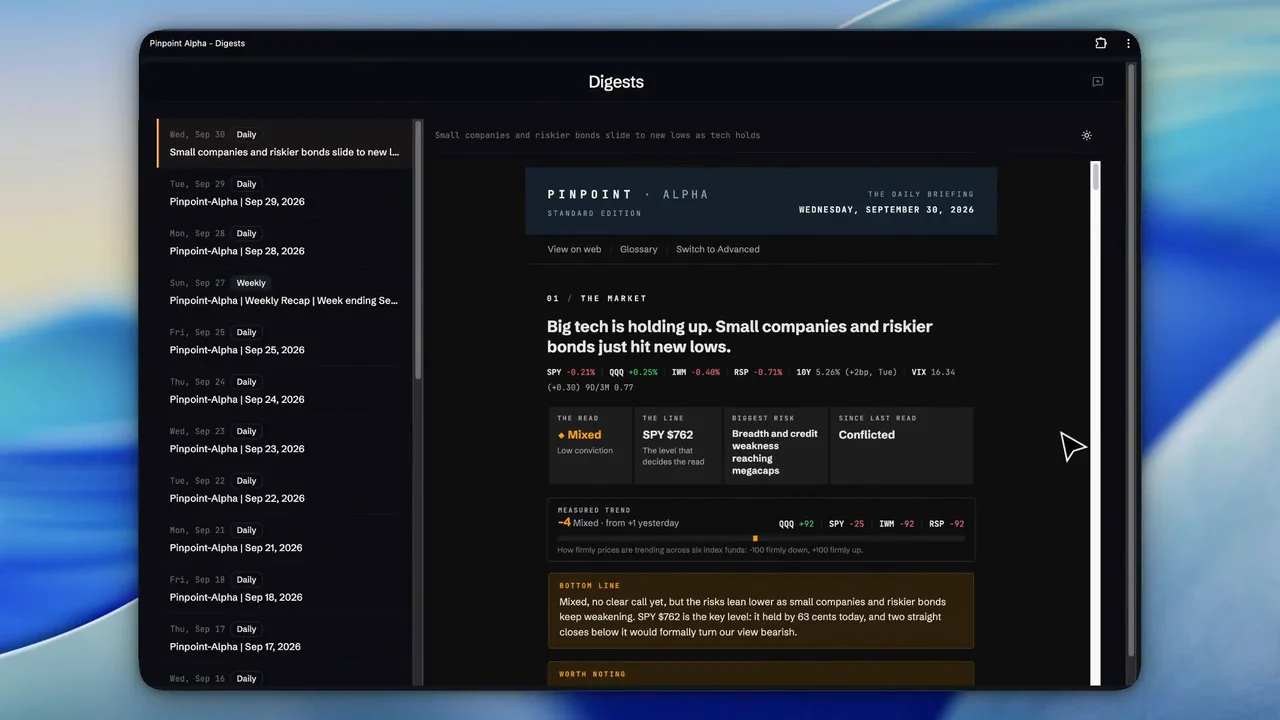
Everything that mattered today, read in under 10 minutes. The brief takes a clear stance on the market and on each stock you follow, names the price that would prove it wrong, and checks yesterday’s call against today’s close.
- The market read: a direction, a conviction, and the one index level that decides it
- Your watchlist ranked by what changed tonight, with quiet names folded away
- Levels to watch on every name: what confirms the read and what breaks it
- Plain English or Advanced edition, reaching the same conclusion either way
Signal Lab
The evidence behind the brief, laid out so you can check it yourself. See the market’s regime and which way institutions are leaning, then open any stock you follow to see the flow, levels, and options activity behind its read.
- Regime, credit, and the yield curve at a glance, with how long each has held
- A trend score that raises plain-English caution flags when a move gets stretched
- Your watchlist sorted by unusual activity, with support and resistance on each
- Replay the last 10 sessions on any name to see how its read developed
Intraday
Four snapshots of the session, from the first hour to the close. Each window’s options activity is cut down to the few dozen trades that stand out, so you can check in on your schedule instead of watching a screen all day. Not a live feed.
- Updated after the first hour, midmorning, lunch, and the close
- The largest options bets of each window, with the noise filtered out
- Block trades ranked against 10 years of each stock’s own history
- Whether retail or institutions are driving the index tape today
Sector Rotation
See which parts of the market are gaining ground on the S&P 500 and which are slipping, across 11 sectors and 8 industry groups, from semiconductors and software to regional banks and biotech.
- Leaders and laggards ranked by 20-session relative strength
- Returns against SPY over a day, week, month, quarter, or year to date
- How many sectors are improving at once, so you know if a move is broad
- VWAP-based options activity model and dark-pool dollars by sector for the latest session
Flow Radar
Ideas from outside your watchlist, without running a scanner yourself. Each session we screen the whole US stock market for unusual options activity and keep a short list worth a look, usually around ten names, each with its reasoning written out.
- Reversal Watch: exhaustion after a long rally, or capitulation after a deep drop
- Big Movers: the day's biggest moves with busy options trading behind them
- A public record: every Reversal Watch call is graded at 1, 2, 4 and 8 weeks
- Every card explains why it was flagged; open one for the full price history
Level Map
The price levels the options market is built around, for SPY, QQQ, IWM, and every stock on your watchlist. See how far price sits from support and resistance, and whether dealer hedging is likely to calm moves down or make them bigger.
- Support, resistance, and the price options tend to pull toward at expiration
- Expected trading range for today and the week, from implied volatility
- If-bullish and if-bearish setups with entry, stop, and target at real levels
- What moved since yesterday, and whether options are cheap or expensive
Position Tracker
Log a trade in plain English and keep the plan behind it. Pinpoint tracks your P&L, how far price is from your target and stop, and how the stock is doing against the market and its sector.
- Stocks, ETFs, and single-leg options, entered in a single sentence
- Target, stop, and thesis saved with every trade, with revisions kept
- An in-app flag when price reaches your target or your stop
- Your open trades and their P&L recapped in the Sunday email
Choose your access.
Every new account can try Full Access free for 7 days. No credit card needed.
Pinpoint Alpha
- Daily briefs (Monday to Friday)
- Sunday Weekly Lookback
- Full market-wide macro read
- Up to 15 tickers (any US stock or ETF)
- Signal Lab + Level Map dashboards
- Full Flow Radar (all signals per category)
- Sector Rotation, updated daily New
- Trade Tracking for up to 10 positions New
- Advanced mode: raw metrics and z-scores
- Pattern history that builds on each ticker over time
- No credit card needed
- Nothing is charged when it ends
Billed monthly. Cancel anytime.
Free
A lighter read, three days a week.
- Mon/Wed/Fri evening briefs
- Full market-wide macro read
- NVDA, TSLA, AAPL, MSFT + 1 you pick
- 1 Flow Radar signal per category
- Limited dashboards
- No credit card required
Free account required.
Straight answers
to reasonable questions.
Didn't find yours? Write to admin@pinpoint-alpha.com and a human answers, usually within a few hours.
Pinpoint is built for active swing traders who want to stay on top of the market without spending hours researching every day.
If you typically hold positions for several days, weeks, or months, follow a watchlist of stocks, and pay attention to technical levels, options activity, and broader market conditions, you'll probably find a lot to like.
It's especially useful if you have a day job. You enjoy trading and doing your own research, but you can't spend every afternoon watching scanners, reading X threads, and piecing together conflicting signals.
- High-frequency traders who need tick-by-tick data
- Passive buy-and-hold investors who rarely make trading decisions
- Anyone looking for a service that simply tells them what to buy
Pinpoint helps you stay informed, recognize opportunities, and manage your trading theses. The decisions are yours.
The daily briefing is where most subscribers start, but there's an entire research platform behind it.
Every weekday evening, Pinpoint delivers a market-wide analysis alongside personalized coverage of up to 15 stocks or ETFs on your watchlist. You get the important developments, directional assessments, key levels, and what changed since previous sessions.
When something deserves a closer look, you have a full suite of research tools:
- Signal Lab: Explore market conditions, historical trends, options positioning, and the evidence behind our analysis.
- Flow Radar: Discover noteworthy options activity through curated scanners that prioritize potentially meaningful transactions over raw trade volume.
- Intraday: Four scheduled market check-ins highlighting developing options activity, market conditions, and 0DTE positioning.
- Sector Rotation: Follow changes in sector leadership, relative strength, and where market participation is expanding or weakening.
- Level Map: Explore significant options positioning, open-interest concentrations, and important price levels.
- Options Monitoring: Track specific options contracts, monitor open interest and unusual activity, and configure supported alerts.
- Position Tracker: Plan trades, record entries and exits, track targets and stops, and follow your thesis as conditions change.
There's also a Weekly Lookback every Sunday, where we revisit the previous week's calls and evaluate what held up and what didn't.
The daily brief is designed to save you time. The dashboards give you the depth to investigate the things that catch your attention.
You can spend ten minutes with Pinpoint or an entire afternoon. It's up to you.
There are some excellent options scanners on the market. We've used many of them ourselves.
Their strength is giving you access to enormous amounts of trading data, often with hundreds of ways to filter, sort, and explore it.
But that's also what frustrated us.
We found ourselves juggling multiple scanners, charts, X threads, and financial news sources, spending hours trying to determine which signals were meaningful and what they suggested about the broader market.
We wanted the research, not another pile of data to research.
That's the problem we built Pinpoint to solve.
- Ingest market activity.
- Filter statistically insignificant transactions.
- Compare signals against historical patterns.
- Evaluate them alongside price action, options positioning, and broader market conditions.
- Turn that evidence into analysis covering the market and the stocks you follow.
We have curated scanners and dashboards too, but we've deliberately prioritized interpretation and context over offering thousands of filters.
If you're looking for a one-to-one replacement for every feature in a professional options terminal, Pinpoint may not be what you need.
If you'd rather open your research platform and find that much of the analytical work has already been done, you're in the right place.
Let's say a stock on your watchlist is approaching a major resistance level.
You notice unusual call volume, but the stock hasn't broken out. Is that meaningful accumulation? Hedging? Speculation? And does the broader market support the move?
Answering those questions usually means jumping between several tools and reviewing activity from previous sessions.
Pinpoint does much of that work automatically.
We analyze options flow, price action, positioning, historical patterns, and market conditions to identify developing setups and explain the evidence behind them.
Each analysis highlights:
- The directional lean
- Relevant support and resistance levels
- The conditions that would strengthen or invalidate the thesis
We also maintain context across sessions.
If a bullish setup starts deteriorating, we want you to know what's changed and why. If an important level holds and supporting evidence strengthens, that deserves attention too.
The goal is to help you spend less time hunting through data and more time evaluating opportunities, managing risk, and making informed trading decisions.
Pinpoint provides trading research and market analysis, rather than personalized buy or sell recommendations.
We examine what happened across the broader market and the stocks you follow, compare that activity with previous sessions, and assess what the available evidence suggests.
That includes directional assessments, emerging setups, changes in options positioning, and key support and resistance levels.
For example, we might identify improving bullish positioning in a stock while explaining that a breakout above $150 would strengthen the case, whereas a close below $142 would invalidate it.
You get the reasoning, the supporting evidence, and the conditions worth watching.
We don't decide whether you should enter that trade, how much capital to commit, or when to exit your position. Those decisions depend on your own strategy, risk tolerance, and circumstances.
Our job is to make sure you have a well-researched picture of the market before making them.
Pinpoint combines traditional quantitative analysis with modern language models, with a deliberate separation between the two.
All quantitative calculations happen in code, before AI is involved.
We've built more than 14 specialized Python analysis pipelines that calculate over 60 quantitative signals and metrics. These pipelines process the raw market data, filter transactions, measure options activity, evaluate positioning, identify statistical anomalies, and compare current conditions against historical patterns.
The calculations are deterministic, and we've developed tests and evaluations to verify the pipelines' behavior and outputs.
Once that processing is complete, Claude receives the structured findings, relevant historical context, and supporting market data.
Its job is interpretation.
We use carefully designed analytical prompts built around established concepts in technical analysis, market structure, options positioning, and fundamental market analysis. These instructions define how evidence should be evaluated, how conflicting signals should be weighed, and when uncertainty should be acknowledged.
The model doesn't invent trade statistics, calculate our signals, or independently determine the underlying quantitative measurements.
It examines the evidence our pipelines have produced and develops a coherent explanation of what it may mean.
The result combines the consistency of deterministic analysis with the ability to interpret complex, sometimes conflicting market information.
AI interpretations can still be imperfect, which is why we continue testing, evaluating, and refining the analytical process.
We can identify activity consistent with institutional-sized trading and analyze what it may suggest. But market data doesn't always reveal who placed a trade or why.
A large call purchase, for example, isn't automatically a bullish institutional bet. It could be part of a hedge, a spread, or a transaction closing an existing position.
We account for these limitations in our analysis.
Pinpoint examines transaction characteristics, options positioning, open interest, historical activity, price behavior, and other supporting evidence to assess whether something unusual or potentially meaningful is developing.
We also evaluate how signals compare with each stock's own trading history. An unusually large transaction in one stock might be perfectly ordinary in another.
When the evidence supports a bullish or bearish interpretation, we'll explain the reasoning. When it doesn't, we'll say so.
We'd rather give you an honest mixed assessment than manufacture conviction that the data doesn't support.
Understanding what market activity suggests is valuable. Pretending to know every institution's intentions isn't.
Not at all. We specifically designed Pinpoint for people who can't spend the entire trading session glued to a screen.
Our primary analysis runs after the market closes, incorporating the completed session alongside relevant historical context. Paid subscribers receive their evening briefing on weekdays, typically by 6 PM ET.
That means you can finish work, open your inbox, and get caught up on the market and your watchlist in roughly ten minutes.
If you prefer to check in during the day, our Intraday features provide four scheduled updates highlighting developing market conditions and noteworthy options activity.
The dashboards also let you explore historical signals, monitor options contracts, examine sector rotation, and track your positions whenever it's convenient.
Different datasets have different update schedules. For example, options open interest is generally updated daily rather than continuously throughout the session.
Pinpoint isn't designed to replace a real-time execution terminal. It's designed to help you understand what matters without requiring you to watch every trade as it happens.
We track our calls and evaluate what happened afterward, including the ones that didn't work out.
Every Sunday, our Weekly Lookback revisits the previous week's analysis and examines how individual setups and market assessments developed.
We look at whether:
- Important levels held
- Anticipated moves materialized
- The conditions supporting or invalidating a thesis were met
We're also developing and refining systematic evaluations for our quantitative signals, including how they perform across different market conditions and time horizons.
There's an important distinction between evaluating a market call and claiming that a trading strategy is profitable.
A correct directional assessment doesn't necessarily translate into a profitable trade. Entry timing, execution, position sizing, and risk management all matter.
We believe good market research should be accountable to what happens next.
Some assessments will be right. Others won't. Sometimes the most useful conclusion is that the evidence doesn't support a confident directional call.
We want subscribers to understand the reasoning behind our analysis, see how it evolves, and make their own judgments about its usefulness.
Historical results are not guarantees of future performance.
Yes. Every new account can try Full Access free for 7 days, and the free plan stays free.
Choose up to 15 stocks or ETFs and get the evening brief on each one every trading day, the Sunday Weekly Lookback, and every dashboard.
There's no card on file, and nothing is charged when it ends.
Create a free account and receive market analysis every Monday, Wednesday, and Friday.
The free edition covers four popular stocks, NVDA, TSLA, AAPL, and MSFT, plus one additional ticker you choose. You'll also get limited access to selected analytical features.
Get the complete experience:
- Evening market briefings every trading day.
- Personalized analysis for up to 15 stocks or ETFs.
- Full access to our analytical dashboards and curated scanners.
- Options contract monitoring and supported alerts.
- Trade planning and position tracking.
- Sunday Weekly Lookback reports.
You can change your watchlist as your trading interests evolve.
The 15-ticker limit is intentional. We want subscribers to maintain a focused watchlist with meaningful analytical context, rather than receive superficial coverage of hundreds of securities.
No long-term commitment. Cancel your monthly subscription anytime.
Start with the trial or the free plan, explore the analysis, and decide whether Pinpoint fits your trading process.
You get 7 days of Full Access from the moment you start. Your account shows the exact end time in Eastern Time.
- Start before the evening brief goes out and that evening's brief covers your tickers. Start after it and tonight's brief is ready to read in the app straight away.
- There's no card on file. Nothing is charged when it ends.
- A day before it ends we email you what stays on Free and what pauses.
- When it ends your account moves to Free on its own: the Monday, Wednesday and Friday brief on four preset stocks plus one you choose.
- Nothing is deleted when it ends. Anything over the free limits is paused. Subscribe within 30 days and your monitors and extra tickers come back exactly as they were; after that they are removed. Tracked trades are never removed: they stay paused until you subscribe.
- One trial per person. You can move to Full Access at any time, during the trial or after.
Pinpoint publishes market research about the tickers you choose. It is not investment advice and does not recommend buying or selling any security.

